Venice Says It Earns $150 Million a Year. VVV Gets About a Tenth of It.

Venice is one of the few AI companies whose sales you can read off a blockchain. Its chief executive, Erik Voorhees, said on October 14 that revenue is now above $150 million a year. We counted the burns on Base and got about $123 million. The more interesting number is what reached the token in October's first 18 days: about 10% of the company's figure and 12% of ours, through a burn the company sizes itself and can stop at any time. Dollar figures use $24.46 per VVV, the price on October 20, 2026; the chain data runs to October 18.
Key Takeaways
- The business is real and growing. Seventeen days of burns on Base work out to about $336,000 of sales a day, four fifths of it API credits. Two longer series, per-sale burns and tokens served through OpenRouter, have risen since August.
- The token has no claim on any of it. Revenue belongs to Venice.ai. What VVV gets is a burn the company decides, and a mint rate one multisig can change.
- Supply is still growing. At October's full-month pace, burns cancel about a quarter of new minting. The share rose mostly because Venice cut the mint rate, not because it burned more.
- The market prices the token like the company. VVV is worth $1.19 billion to $1.98 billion; the Series A valued Venice itself at $1 billion. A year of burns at today's pace is about 1% of that.
What Venice is and how VVV works
Venice sells private AI, meaning a chat and image app and a developer API, run by Venice.ai, a Wyoming corporation that raised $65 million in July 2026 in a round led by Dragonfly. VVV is its token on Base.
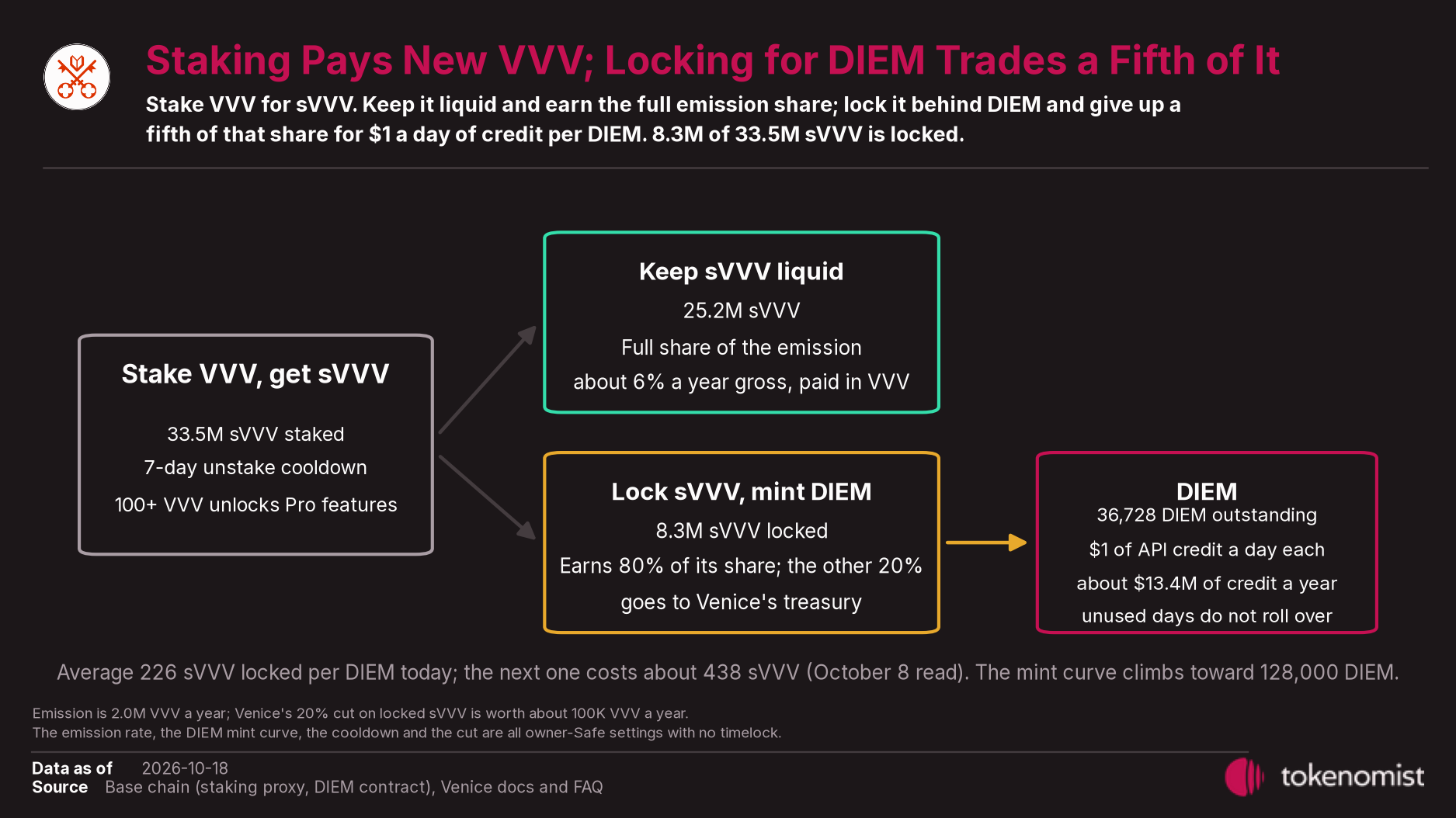
The token does three things. Stake it and you receive newly minted VVV, about 6% a year at today's stake. Staking also unlocks Pro features in the app. And if you lock your staked VVV, you can mint DIEM, a second token that entitles you to $1 of API credit a day, for as long as you hold it. What VVV does not do is give you any claim on Venice's revenue or equity.
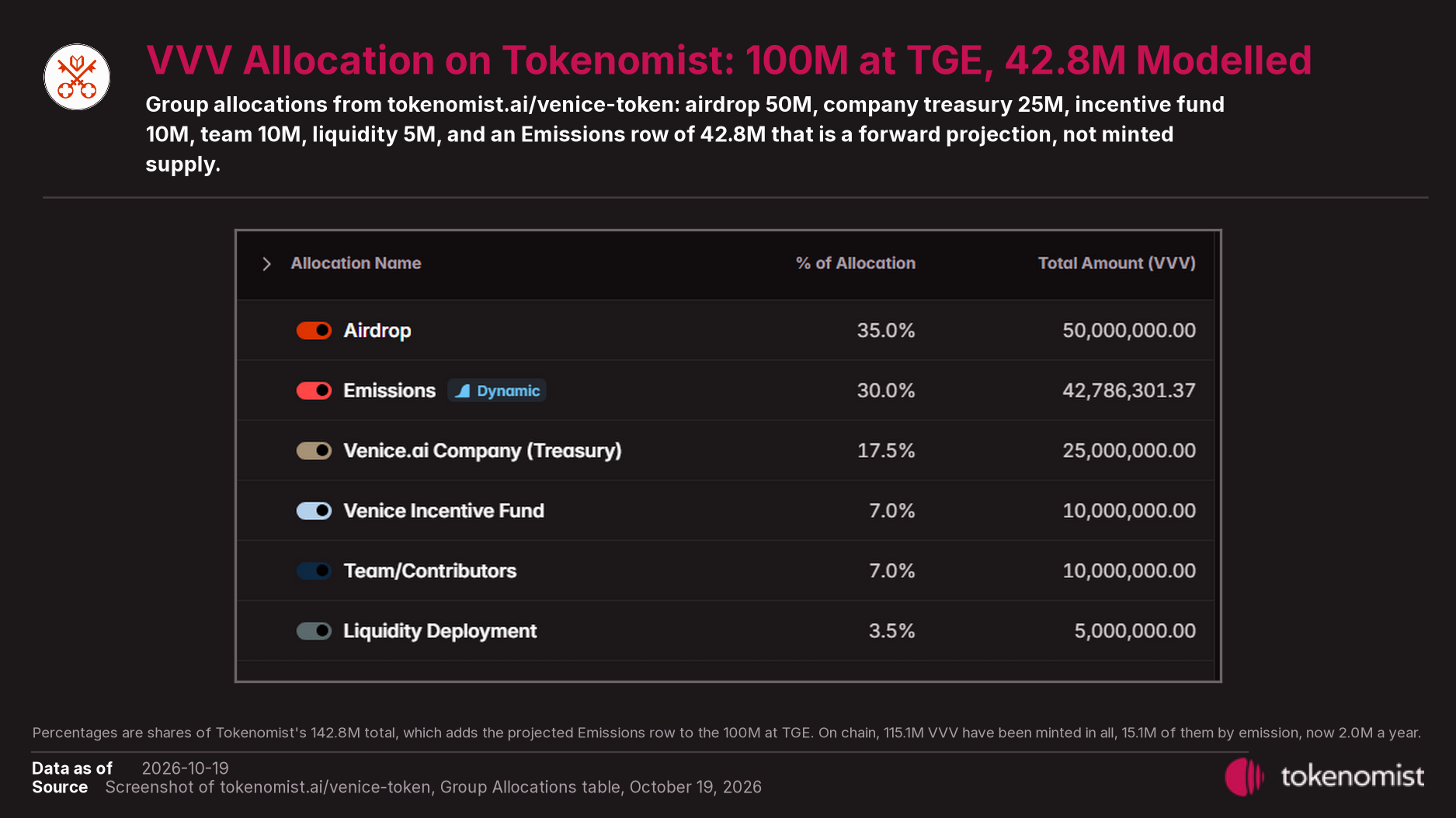
At the token generation event (TGE) on January 27, 2025, Venice created 100 million VVV and split them five ways, per its launch post:
- 50 million: airdrop
- 25 million: company treasury
- 10 million: incentive fund
- 10 million: team
- 5 million: liquidity
Most of the airdrop was never claimed. Venice burned the unclaimed 32.5 million in March 2025, which is why the token already shows 33.9 million burned: almost all of that number is the airdrop, not buybacks.
Since then new VVV has come from one place, the staking contract. It mints 2.0 million a year today, down from 14 million at launch. The team's 10 million, already counted in the 100 million, vests at about 10,300 VVV a day until late January 2027; that moves tokens into circulation but creates none. So when this piece says "supply", it means total supply: 115.1 million minted, less 33.9 million burned, leaves 81 million outstanding.
1. October burns imply about $123 million a year in sales
Start with what makes Venice unusual. Its burn rules are fixed and public (April 15 and July 17, 2026):
- $2 of each $18 Pro month
- $5 of each $68 Pro+ month
- $10 of each $200 Max month
- 5% of each API credit purchase
Every time a customer pays, the burn wallet spends a fixed amount of USDC to buy VVV and destroy it. The amounts differ slightly by product, so each payment on chain tells you which product it was. Count the payments and you have counted the sales.
From October 1 to 17 the wallet made 93,837 of them. Read as sales, that is about $336,000 a day, or $123 million a year. The mix is the surprise. 81% of it is API credits, bought by developers, not subscriptions bought by people in the chat app.
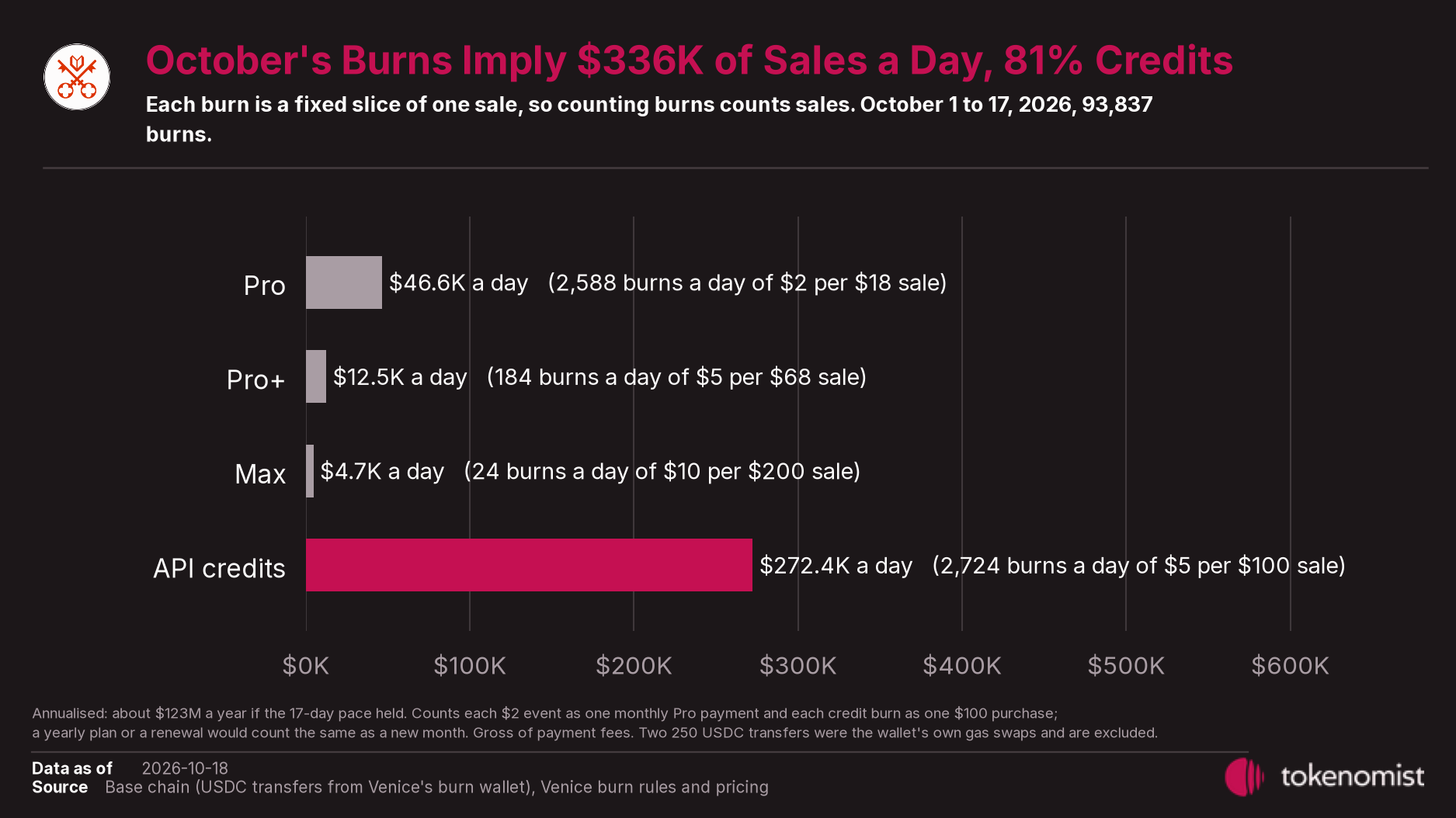
That mix matters for the token. Credits burn 5% of each purchase, tied with the Max plan for the lowest rate; subscriptions as a group burn about 10%. Blend them and the automatic burn takes about 6% of sales, and most of the growth since July has come on the side that burns least. Unless Venice changes the rules, that automatic share stays near 5% to 6%. Anything above it has to come from the monthly burn the company decides by hand.
Here is the claim we are testing against.
Venice daily token demand is now >500b and annual revenue is now >$150m
— Erik Voorhees (@ErikVoorhees) October 14, 2026
Our $123 million sits between the $100 million Voorhees stated on August 17 and the $150 million of October 14, and the method has three known biases. Renewals may not trigger a burn (Venice's April post says new subscriptions do, its July post says every payment does), which would make our count too low. A discounted yearly plan counts as one month, also too low. And the figure is before payment fees, which makes it a touch high. So the chain neither confirms nor rules out $150 million. It does say the business is of that order, and that it is growing: payments a day rose 13% from the first week of October to the third (October 1 to 7 against 11 to 17).
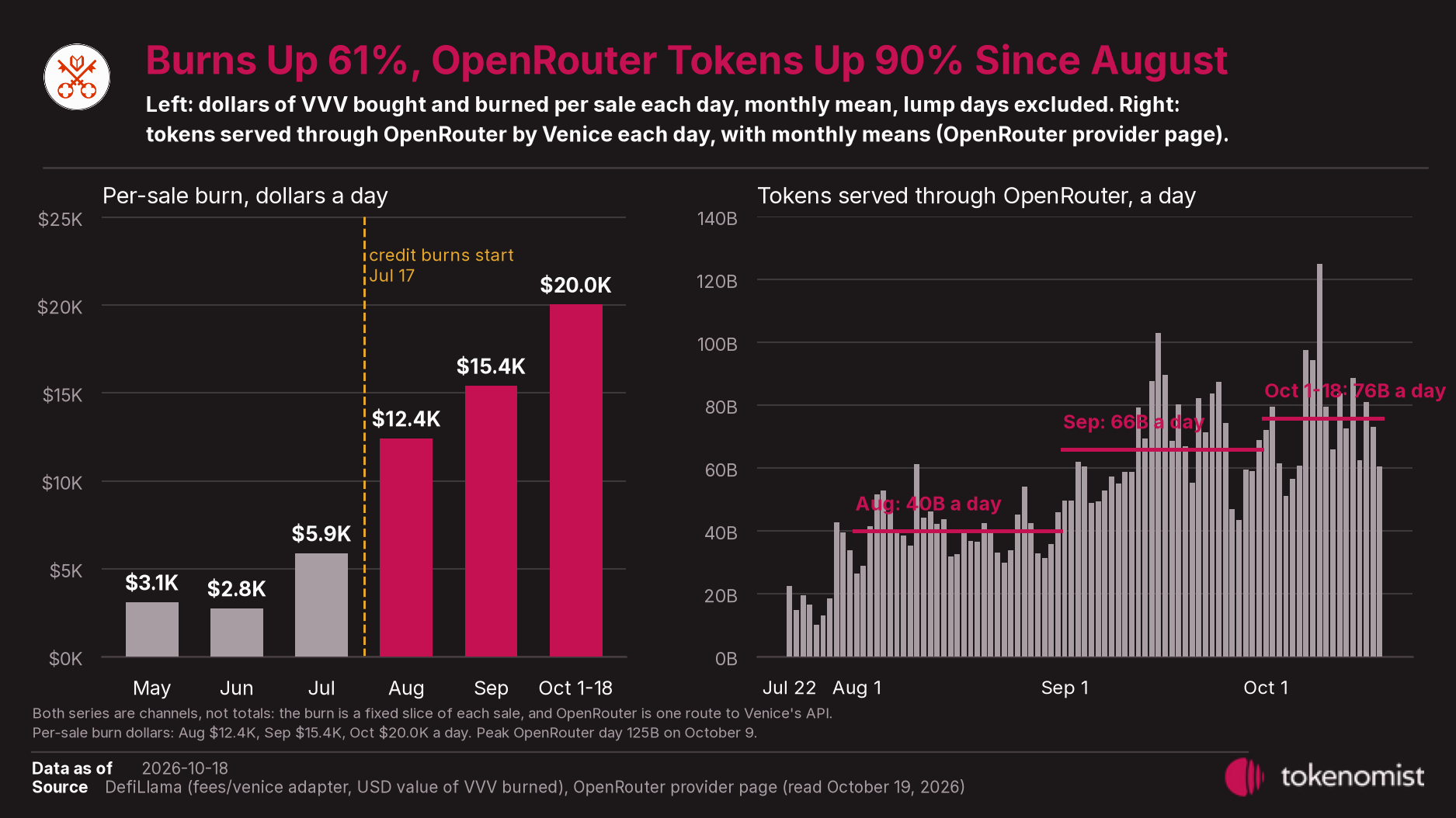
Two longer series tell the same story. The per-sale burns, in dollars, averaged about $5,900 a day in July, $12,400 in August and $20,000 in October, up 61% since August (credit burns only began on July 17, so July is subscriptions only). Tokens served through OpenRouter by Venice went from 40 billion a day in August to 76 billion in October, up 90%. Venice said on July 1 it processed 1.3 trillion tokens a month, about 43 billion a day; OpenRouter alone now routes more than that, so the total has grown since and OpenRouter is a large part of it rather than a side channel. Neither series is a total. Both rise.
2. VVV has no claim on Venice's revenue
Now follow the money, because this is where the story turns.
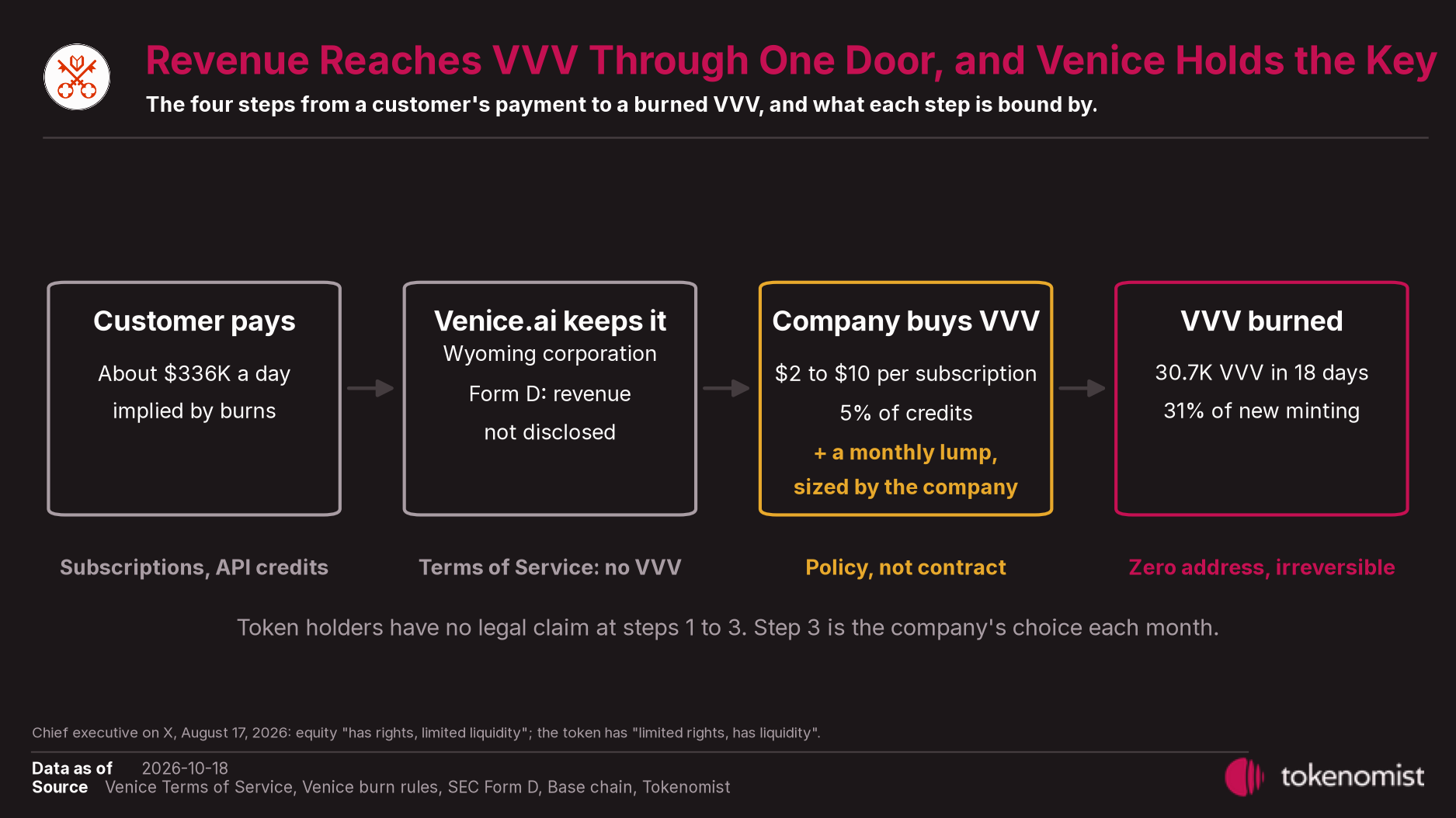
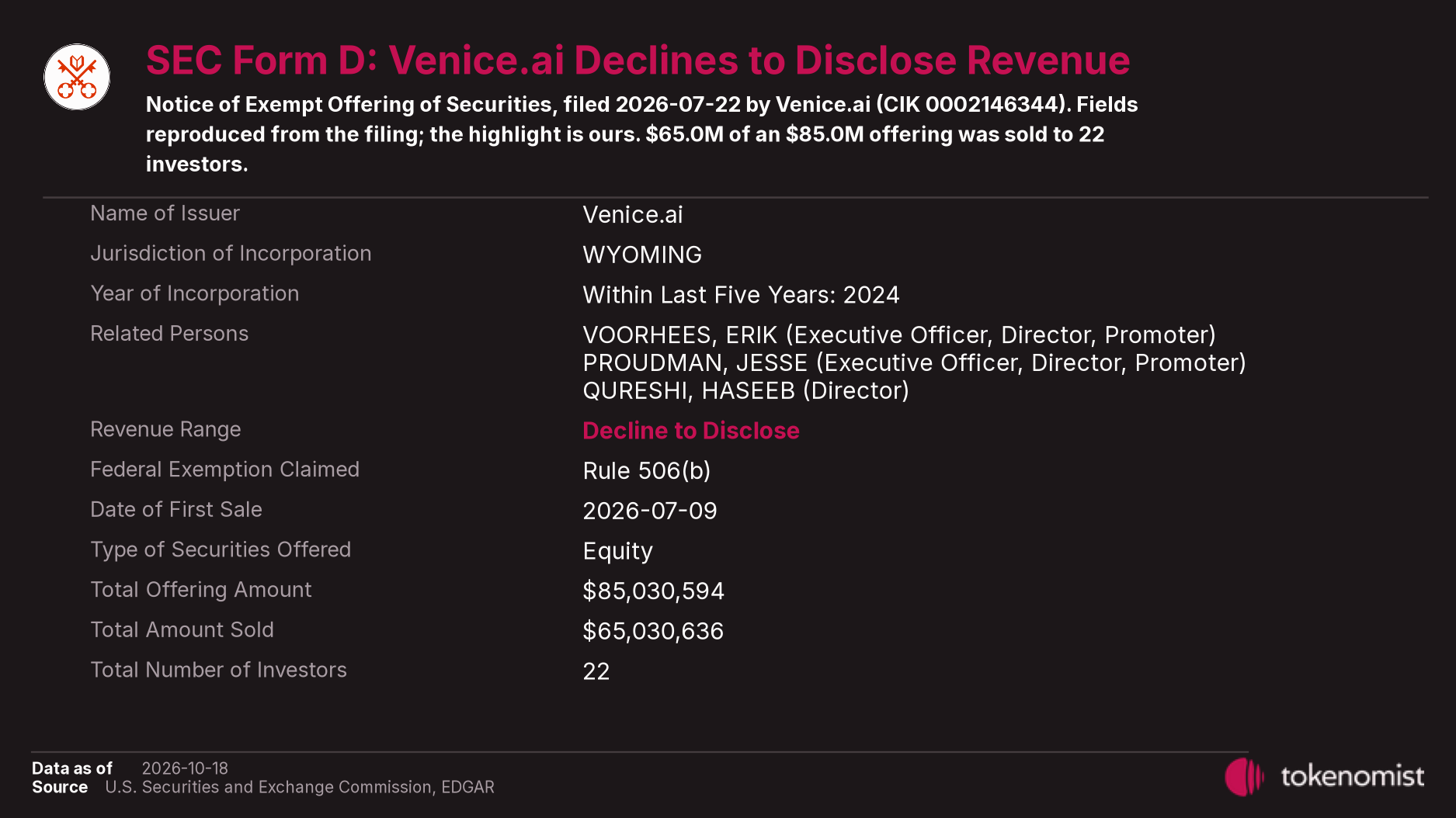
Every dollar of that revenue belongs to Venice.ai, the company. The Terms of Service do not mention VVV at all. The Form D Venice filed with the SEC in July declines to state revenue, which the form allows; what it does show is $65.0 million sold to 22 investors out of an $85.0 million offering. Voorhees has said the same thing in his own words: equity "has rights, limited liquidity," the token has "limited rights, has liquidity," and a minority holder cannot force a dividend.
Equity: has rights, limited liquidity
— Erik Voorhees (@ErikVoorhees) August 17, 2026
Token: limited rights, has liquidity
Some revenues have begun flowing to the token, zero revenue has flowed to equity.
Equity is the largest holder of token, and benefiting the token is one of the highest leverage things equity can do to…
Venice's answer to this is alignment. The company is the largest holder of its own token, so it gains when the token does. In his July 1 thread Voorhees put the holding at "more than 30m out of today's 80m supply"; the owner Safe we can see on chain held 20.75 million on October 18, about $508 million and a quarter of everything outstanding; where the rest of the 30 million sits, we cannot see. The Series A investors got the same arrangement: 8.98% of the equity, plus a 1.5 million VVV grant and the right to buy 5 million more. Everyone at the table holds both the company and the token. The person who holds only the token holds neither a share of revenue nor a vote.
3. The burn share rose in October, mostly because minting fell
The simplest way to see the burn is against the minting it is meant to offset.
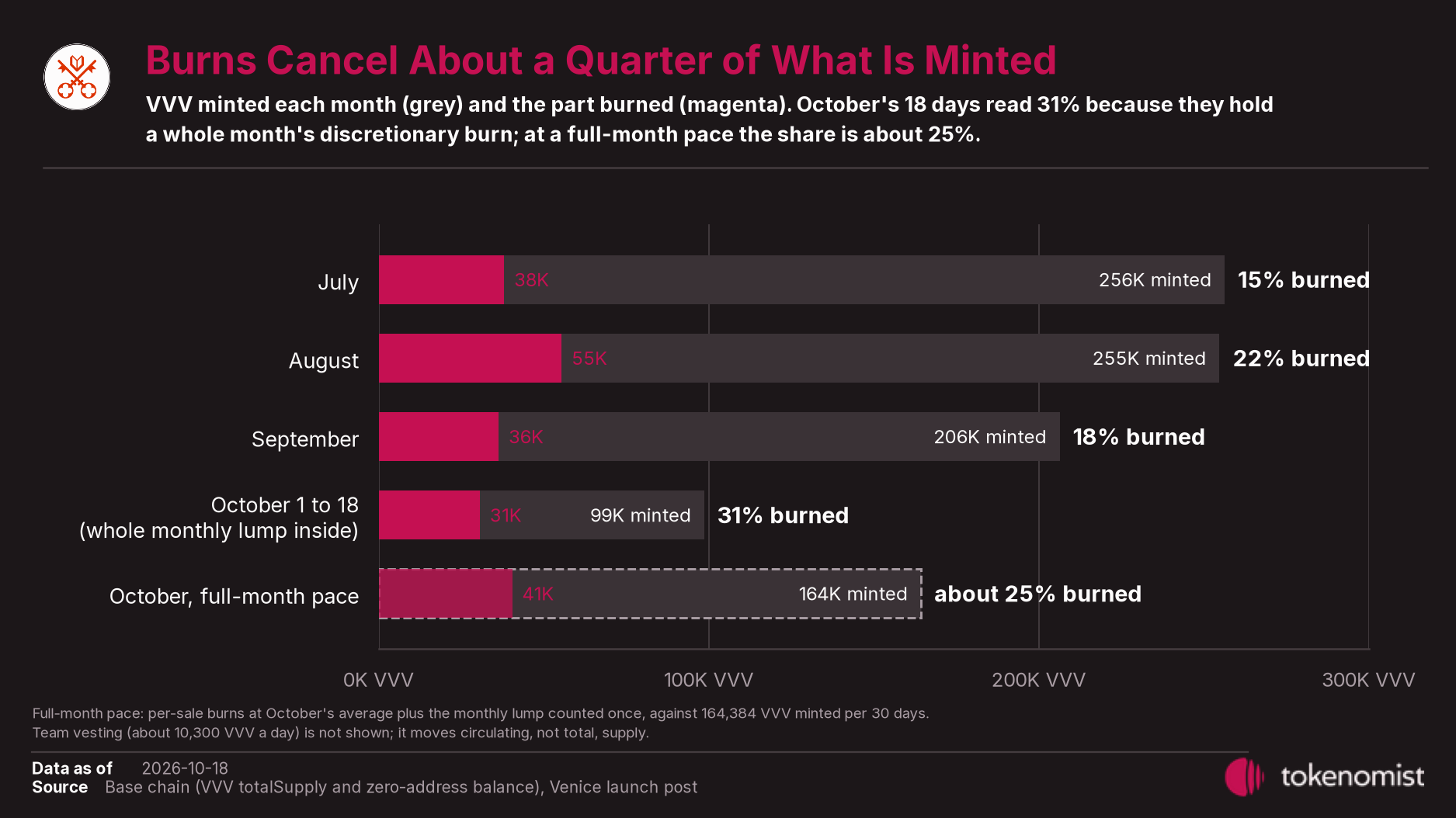
Over the summer, burns cancelled between 15% and 22% of what was minted. October's first 18 days read 31%, which looks like a jump. Most of it is not. The mint rate was cut to 2.0 million a year on October 1, so there was simply less new VVV to cancel. The per-sale burns did climb, from about 660 VVV a day in September to about 910 in mid October, but mostly because VVV got cheaper and the same dollars bought more tokens.
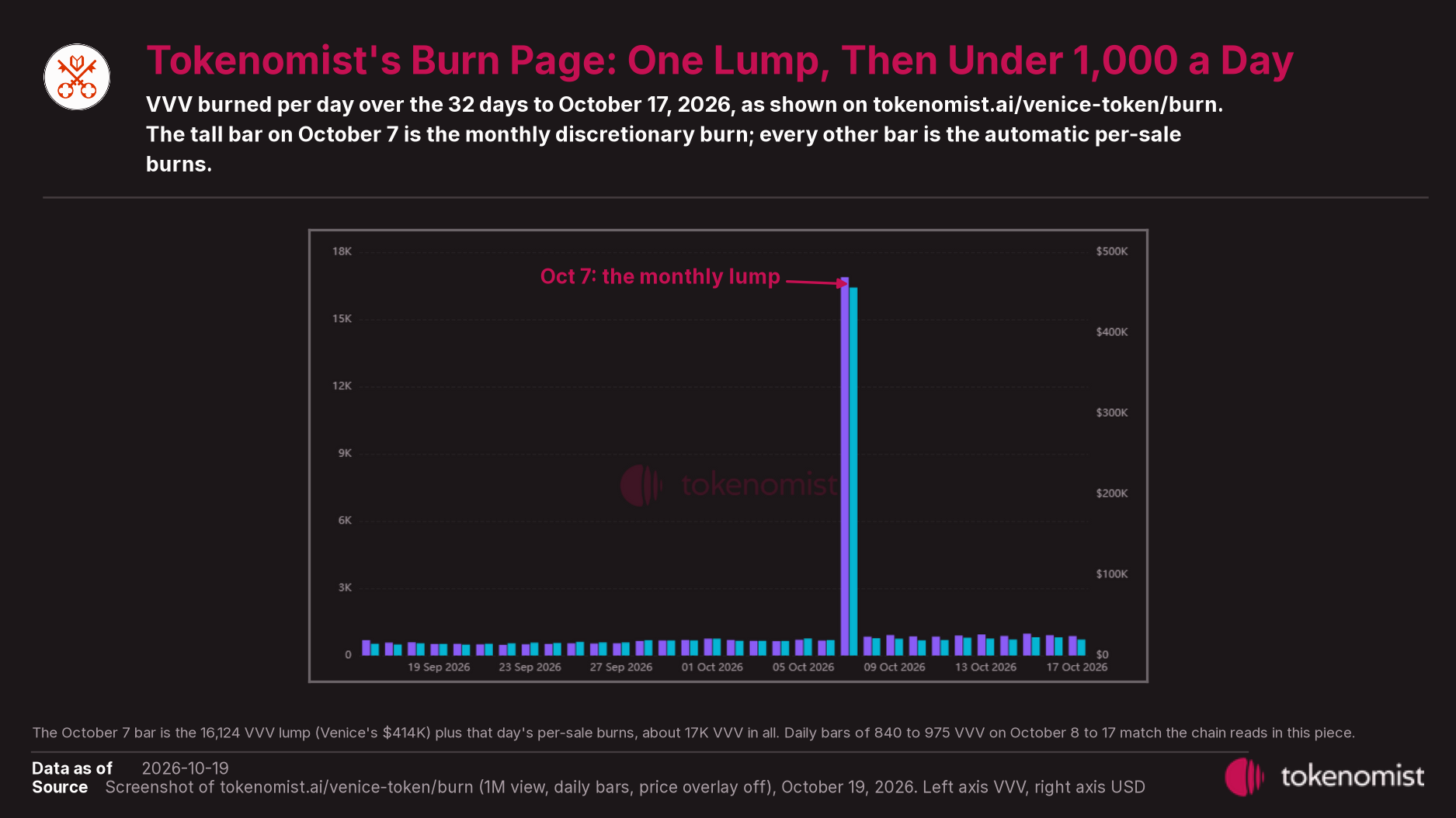
The rest of the jump is a timing effect, and it is worth understanding because it will recur every month. Venice makes two kinds of burn. The small ones run automatically with every sale. The big one is a single discretionary burn the company decides each month: in October it was 16,124 VVV, sent on October 7 from a second company Safe, and it was more than half of everything burned that month. Venice valued it at $414K. Put a whole month's lump against only 18 days of minting and the share looks higher than it is.
On a full-month basis, the per-sale burns cancel about 15% of minting and the lump another 10%. Call it a quarter, or roughly 40,600 VVV a month. That is below August, when Venice burned 55,498. Total supply keeps growing, and circulating supply grows faster: the team's vesting, which creates no new tokens but moves them into circulation, released about six times as much VVV over the same 18 days as the burns removed.
4. Holding supply flat would take 32% to 48% of revenue
The next question is how much Venice would have to burn for the token to stop inflating. At today's mint rate, 164,384 VVV a month, about $4.0 million at $24.46. Set that against the revenue figures in play and the gap is clear.
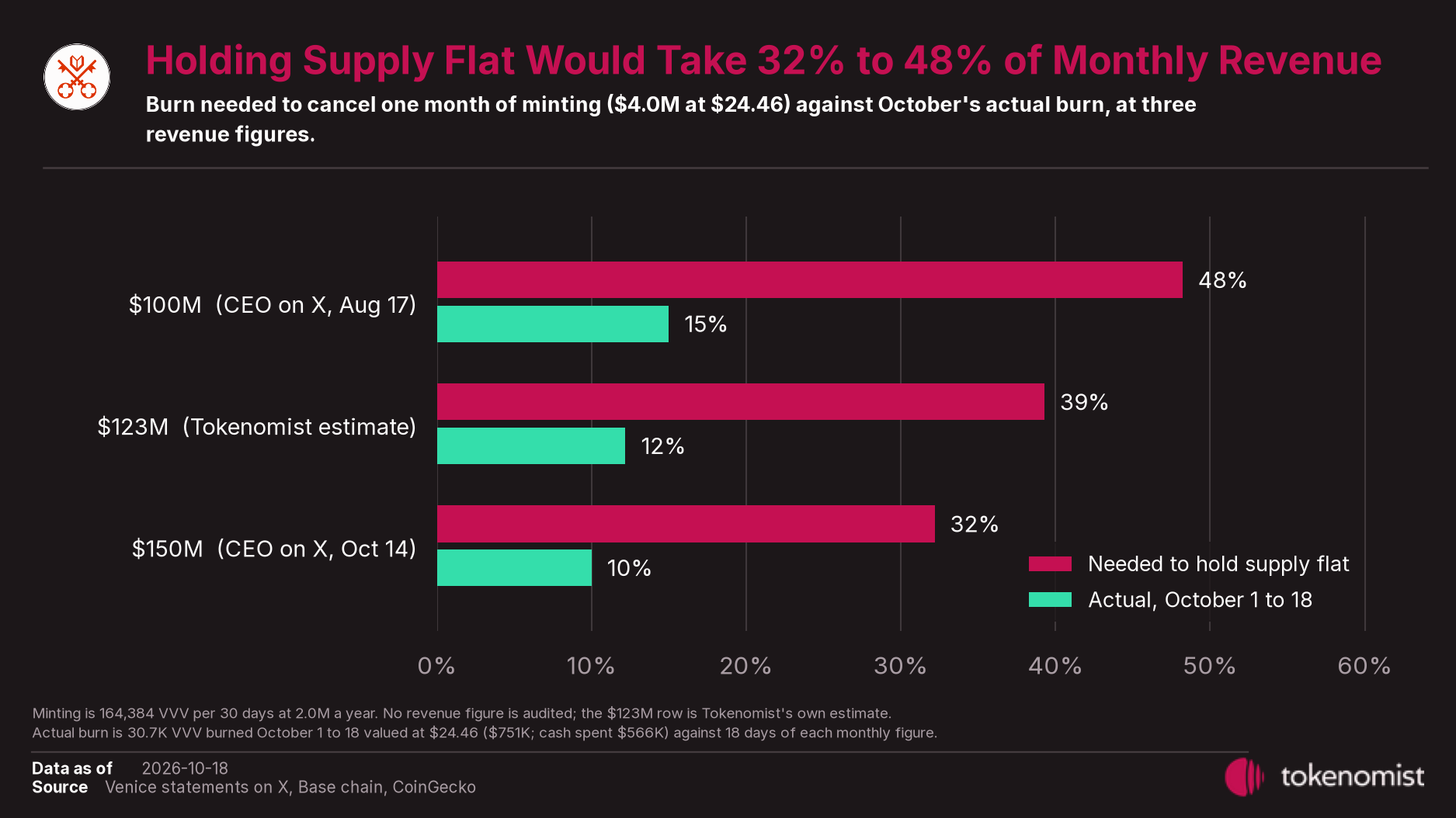
If revenue is $150 million, as the chief executive says, holding supply flat would take 32% of it every month; October's burn was worth about 10%. On our $123 million the numbers are 39% and 12%, and on the $100 million of August 48% and 15%. Those October shares carry a whole monthly lump inside 18 days; at the full-month pace from section 3 they are about 8% and 10%. Whatever figure you believe, the burn would have to be about four times bigger before minting stops adding to supply, and that leaves the team's vesting aside.
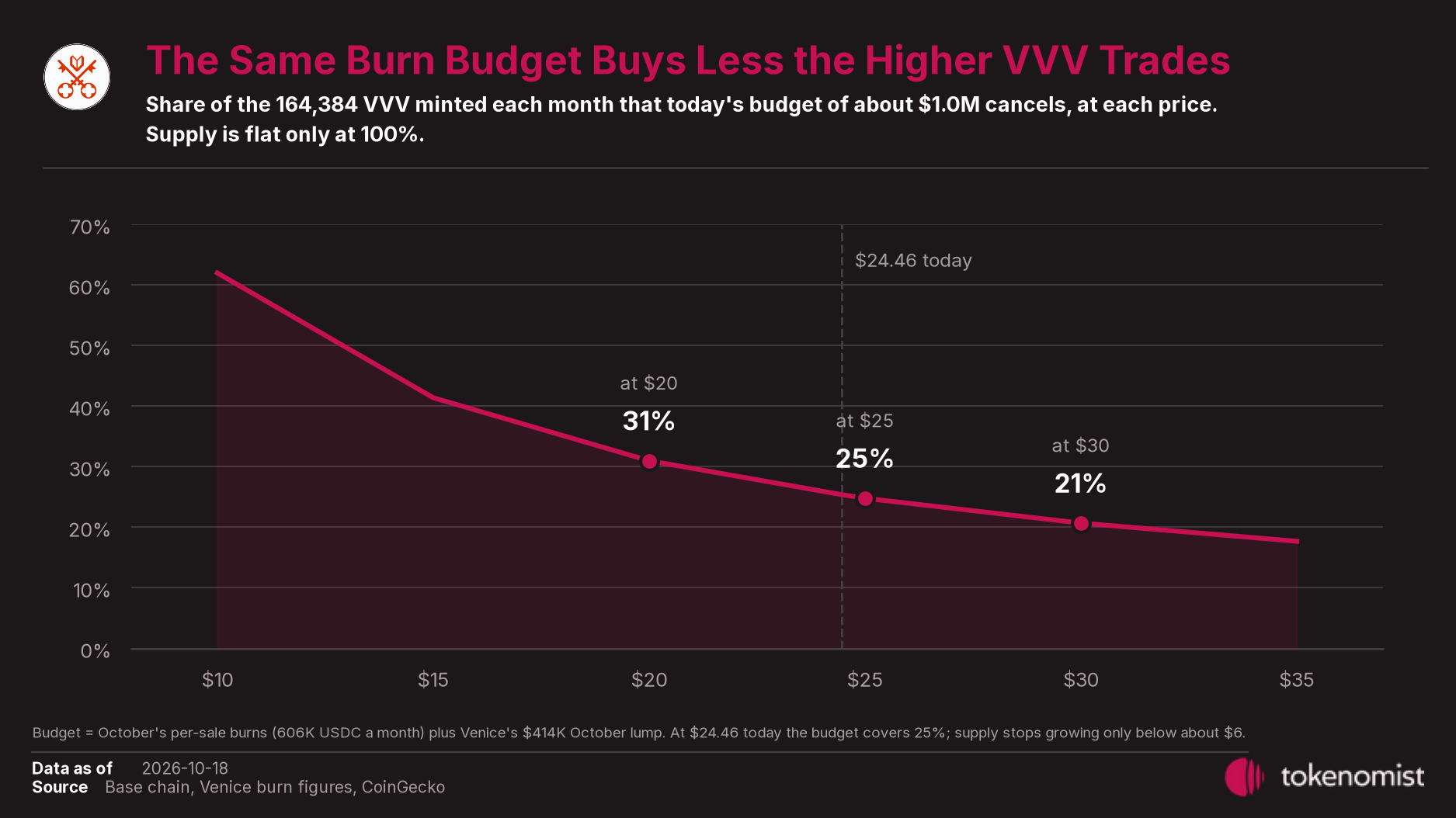
Price cuts the other way. Minting is fixed in tokens, but the burn is spent in dollars, so the higher VVV trades, the less the same dollars burn. Today's budget of about $1.0 million a month cancels 31% of minting at $20, 25% at $25 and only 21% at $30. At that budget, supply stops growing only below about $6.
Venice has said larger burns become "feasible" once it owns its compute. It has not said when, or how much.
5. What holders receive, and what the market did with it
VVV traded at $24.46 on October 20, 2026, up 7.0% over 7 days and down 10% over 30 days, 29% below its intraday high of $34.53 on September 21. This piece does not try to explain the price.
What the piece can say is what a holder actually receives. It is not a payment. It is a share of revenue that Venice chooses to spend on burns each month, and in October that share was about 10% to 12%, depending on whose revenue figure you use.
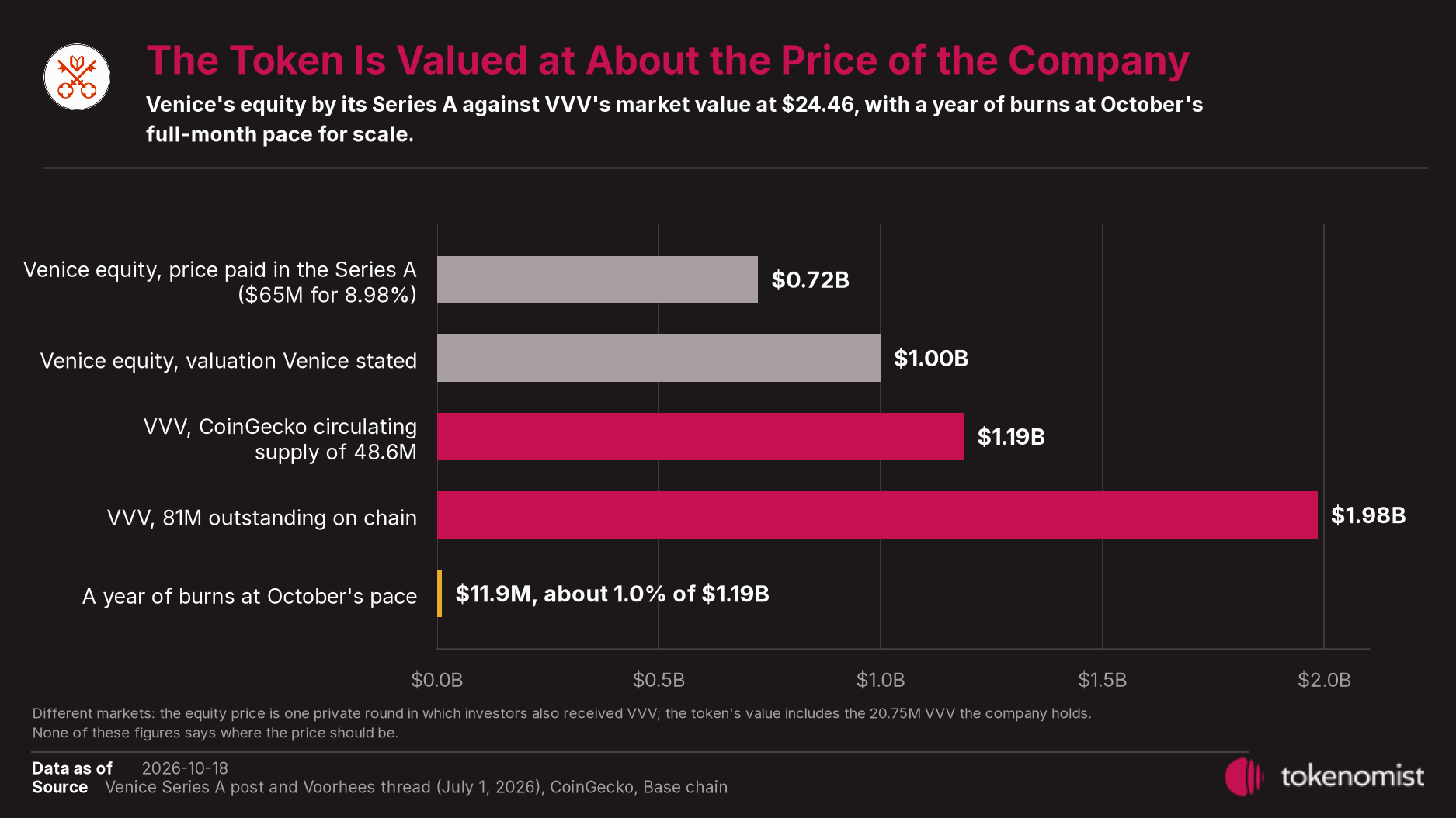
Set against that, the market values the token at the price of the whole company, or above it. Venice's Series A valued the business at $1 billion by its own account, and the $65 million paid for 8.98% implies about $724 million; the gap is the terms, which also gave investors VVV. VVV at $24.46 is worth $1.19 billion on CoinGecko's circulating supply, or $1.98 billion on everything outstanding on chain. A year of burns at October's full-month pace is about $11.9 million, roughly 1% of the lower figure.
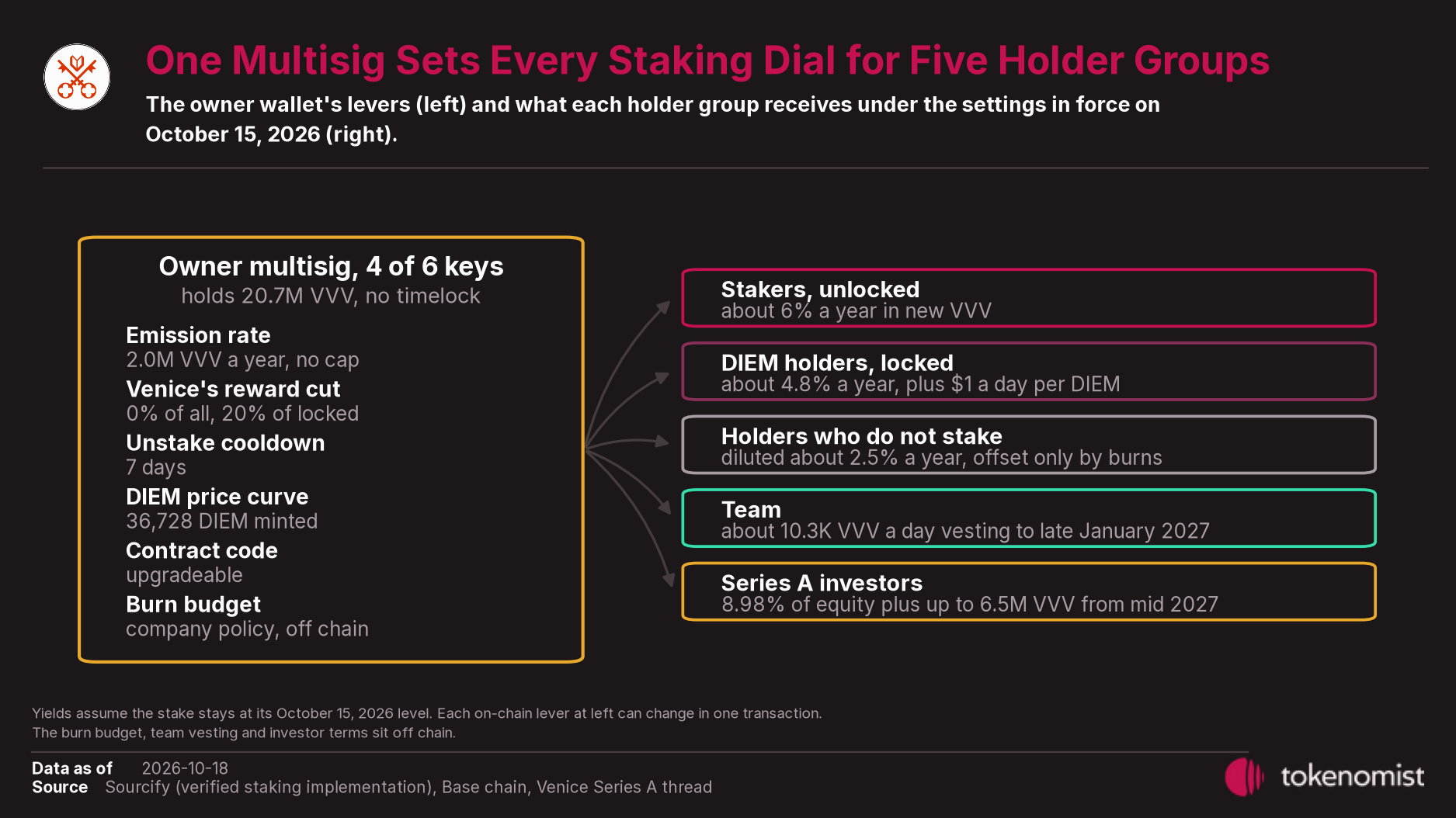
VVV is not equity in Venice. It is a bet that the company keeps choosing to pay the token. The record so far says it has: Venice owns a quarter of the supply, has cut the mint rate six times this year, and has burned in line with the rules it published in the month we checked. The code says nothing requires it to. Every setting that decides what a holder gets sits behind one 4-of-6 multisig, with no timelock.
6. What to watch
Four dates will tell you more than any model. Two of them are the company's own choices and arrive within a month.
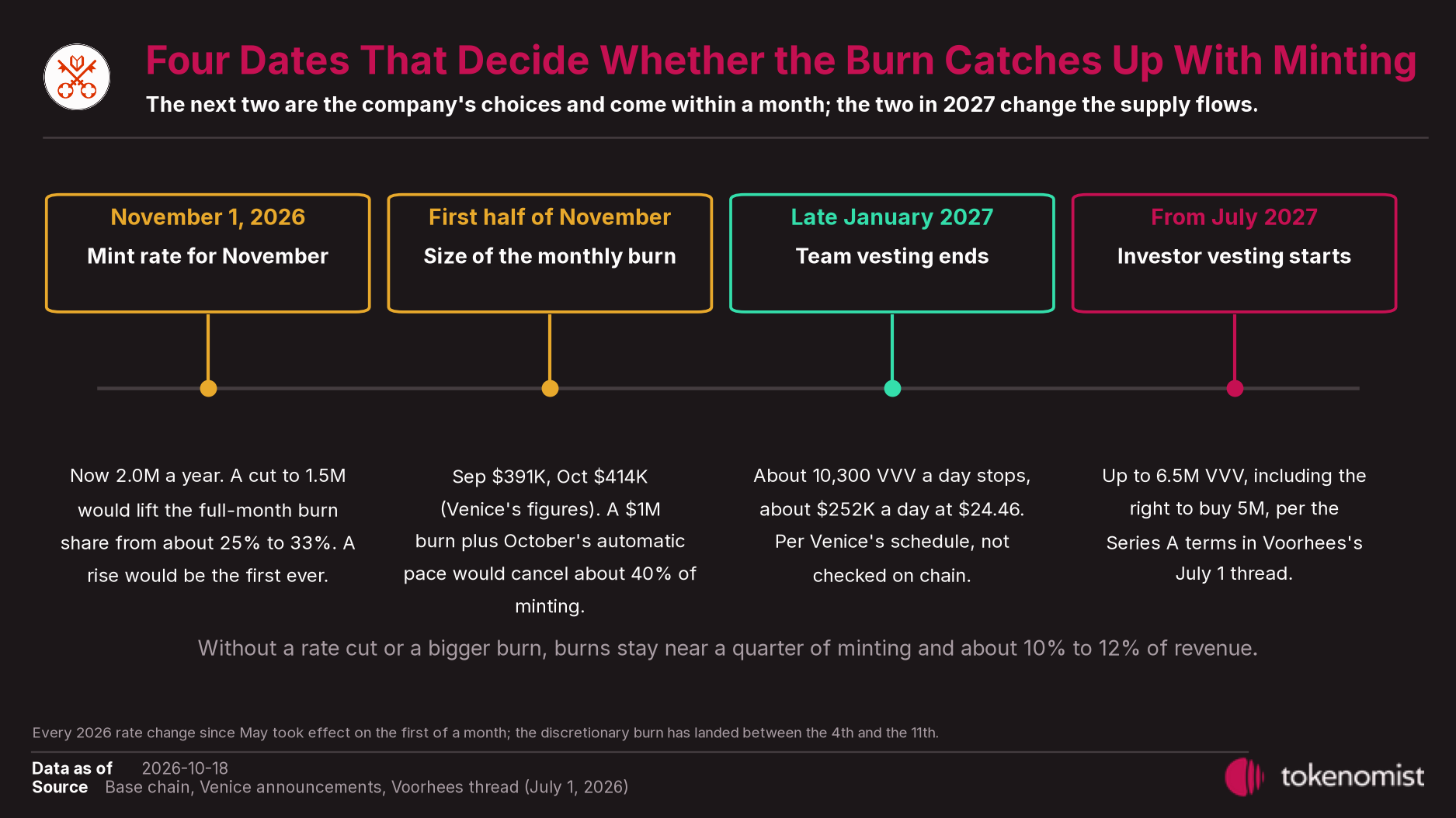
On November 1, watch the mint rate. Every change since May has landed on the first of a month, and all of them were cuts; a cut to 1.5 million a year would lift October's full-month burn share from about 25% to about 33%, and a rise would be the first ever. In the first half of November, watch the size of the monthly burn: September's was $391K and October's $414K, by Venice's figures, and a $1 million burn on top of October's automatic pace would cancel about 40% of minting. In late January 2027 the team's vesting ends, which removes about 10,300 VVV a day from the flow into circulation. From July 2027 the Series A investors' tokens begin to vest, up to 6.5 million VVV over time.
Without a rate cut or a bigger burn, the token keeps receiving about a tenth of the company's revenue, by the company's choice, and supply keeps growing.
Disclosure: the author holds no VVV and has no position in, or exposure to, the token or to Venice. Tokenomist publishes this article and operates the VVV supply, burn and allocation data it cites.
Methodology
- Chain reads on Base at block 52783839 (October 18, 2026, 20:57 UTC) and at 00:00 UTC month boundaries: minting is the change in VVV total supply, burning the change in the zero-address balance. A month is 30 days (164,384 VVV at 2.0 million a year); "October 1 to 18" is 17.9 days.
- Of the 30,705 VVV burned, 16,124 was one transfer on October 7 from the company's second Safe
0x35fb…dc57; the rest were the burn wallet's per-sale burns. Burns are valued at $24.46 unless stated. Cash spent in the window was about $566K: $361K from the burn wallet, $205K the Safe sent to CoW Swap. - Sales are counted from USDC transfers out of burn wallet
0xe315…82e7, October 1 to 17 (blocks 52011727 to 52746127): 43,997 of 2.015 USDC read as Pro months at $18, 3,126 of 5.0375 as Pro+ at $68, 400 of 10.075 as Max at $200, 46,314 of 5.07 as $100 credit purchases. Two transfers of 250 USDC bought gas and are excluded. Weeks compared: October 1 to 7 and 11 to 17. - Contract logic from the Sourcify-verified implementation
0xe37a…8dca; owner Safe0x2d8c…1524, threshold 4 of 6, no timelock. Price and the 7-day and 30-day changes from CoinGecko at 07:20 UTC on October 20, 2026. Market values: CoinGecko's $1.19 billion on 48.6 million circulating; $1.98 billion on the 81 million outstanding; equity $65,030,636 ÷ 8.98% = $724 million. - Growth series: DefiLlama's Venice adapter values every VVV burn at the day's price; the monthly means exclude the one day a month above $100K, so they track per-sale burns only (DefiLlama labels this "revenue"; it is the burn). OpenRouter daily totals are the Venice provider page's "Tokens processed" chart, read October 19 for July 22 to October 18. The two tokenomist.ai screenshots are from October 19; Tokenomist's 142.8 million total includes a projected 42.8 million Emissions row, and this piece uses the chain's 115.1 million.
- All derived figures (shares, paces, implied sales, market values) are Tokenomist's. In the $123 million case of section 4 the automatic burn is arithmetic from the burn rule, because that revenue figure is derived from the burns; only the discretionary burn is independent of it.
- Not checked: the team vesting stream on chain, the platform refilling the burn wallet, whether renewals or DIEM-funded usage trigger burns.
Sources
- SEC EDGAR: Form D, Venice.ai (July 22, 2026)
- Venice: Introducing the Venice token, VVV (January 27, 2025)
- Venice: Programmatic VVV buy and burns (April 15, 2026)
- Venice: $65 million Series A (July 1, 2026)
- Venice: Tokenomics update (July 17, 2026)
- Venice: Terms of Service (June 8, 2026)
- Venice docs: VVV and DIEM and API pricing
- Erik Voorhees on X: VVV and Capital thread (July 1, 2026)
- Erik Voorhees on X: $100 million revenue (August 17, 2026) and reply on equity versus token rights
- Erik Voorhees on X: $150 million revenue (October 14, 2026)
- Base chain: VVV staking implementation, Sourcify-verified
- CoinGecko: Venice Token (VVV)
- DefiLlama: Venice
- OpenRouter: Venice provider page
- Tokenomist: Venice Token (VVV) page and burn page
Frequently Asked Questions
Is VVV deflationary?
No. From October 1 to 18, 2026 the staking contract minted about 98,700 VVV and burns removed about 30,700, so total supply rose, by about 3,800 VVV a day against about 5,700 a day in September. Supply falls only in a month where burns exceed about 164,000 VVV at the current mint rate of 2.0 million a year; October's pace, automatic burns plus the monthly lump counted once, is about 40,600. The last month in which supply fell was March 2025, when the unclaimed airdrop was burned.
Does VVV give holders a share of Venice's revenue?
No. Revenue belongs to Venice.ai, whose Terms of Service do not mention VVV. The only transfer from revenue to the token is the burn, which follows company rules the company can change. Its chief executive has said the token has "limited rights" and that a minority holder cannot force a dividend.
How much of Venice's revenue goes into VVV burns?
From October 1 to 18, 2026 the VVV Venice burned was worth about $750,000 at $24.46. That is about 12% of the $123 million a year implied by burn-wallet payments for roughly the same days (sales to October 17, burns to October 18), and about 10% of the $150 million the chief executive claimed. At the prices on the days it ran the burn was worth about $780,000; cash spent was about $566,000, because part of the October 7 lump came from VVV Venice already held.
Can Venice increase VVV emissions?
Yes. The mint rate is set by the staking contract's owner, a 4-of-6 multisig, through a function with no upper limit in the code and no timelock. Every change so far has been a cut, from 14 million a year at launch to 2.0 million on October 1, 2026, but one transaction could raise it.
Recommend Article